


How Do Museum Audio Tours Work?

The Ultimate Guide to Museum Audio Tours: How They Work and Why Our UHF Technology Leads the Way
Museums are no longer just quiet halls of artifacts; they are immersive storytelling environments. If you’ve ever walked through a world-class exhibit and wondered how the information finds its way seamlessly to your ears, you’re looking into the fascinating world of audio tour systems.
Whether you are a museum curator, a professional tour guide, or a visitor, understanding the mechanics of these systems is key to delivering (and receiving) a premium experience. In this guide, we’ll break down the technology behind museum audio tours and introduce you to our professional-grade, lightweight solution designed for global use.
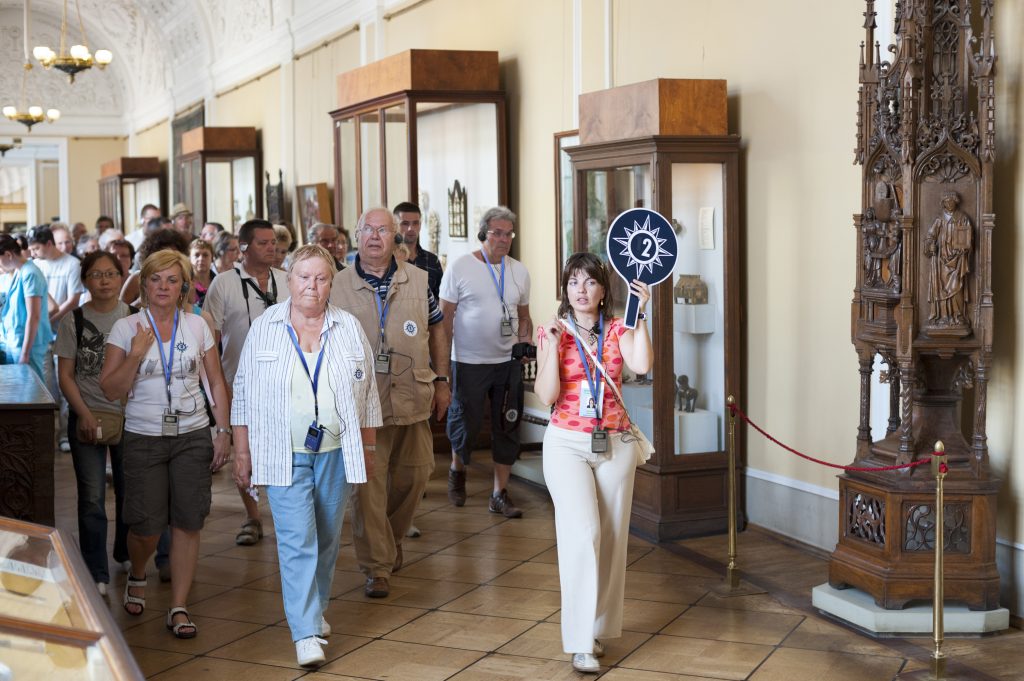
1. How Do Museum Audio Tours Work?
At its core, a museum audio tour system consists of a transmitter (used by the guide) and multiple receivers (used by the visitors). The process can be broken down into three simple steps:
- Input: The tour guide speaks into a microphone connected to the transmitter.
- Transmission: The device converts the voice into a radio frequency (RF) signal.
- Reception: Visitors, wearing receivers tuned to the same channel, hear the crystal-clear audio through their headphones.
Traditional vs. Real-Time Systems
While some museums use “wand” style devices where you type in a number to hear a pre-recorded track, modern tours favor real-time wireless systems. These allow for spontaneity, Q&A sessions, and a personal touch that a recording simply cannot match.
2. Key Technical Features of Our Audio Tour System
To provide a seamless experience, an audio system needs to be reliable, clear, and easy to carry. Here is how our product specifications translate into a superior tour experience.
Global Compliance: 2403-2483MHz Frequency
One of the biggest headaches for tour operators is local radio regulation. Our system operates on the 2403-2483MHz band.
- Why it matters: This is a legal and license-free frequency worldwide. Whether you are conducting a tour in the Louvre in Paris or the Metropolitan Museum in New York, you don’t have to worry about legal hurdles or interference with local radio stations.
50 Available Channels
Museums are often crowded, with multiple tour groups operating simultaneously.
- The Advantage: With 50 independent channels, up to 50 different groups can operate in the same wing of a museum without their signals crossing. You’ll never have to worry about your group accidentally overhearing the guide from the group next to you.
Long-Distance Clarity: Up to 200 Meters
Museum galleries can be vast. You don’t want your group huddled together like sardines just to hear the guide.
- The Benefit: Our system supports a range of up to 200 meters. This allows visitors to linger at an exhibit they find interesting or take photos at a distance while still hearing every word of the guide’s explanation in high-fidelity.
20 MHz Bandwidth
A wider bandwidth ensures that the audio quality is rich and stable. By utilizing a 20 MHz bandwidth, our devices minimize “static” and “dropouts,” providing a studio-quality listening experience that reduces listener fatigue during long tours.
3. Designed for All-Day Comfort
A tour system is only good if people actually enjoy wearing it. We have optimized our hardware for maximum portability.
| Feature | Specification | User Benefit |
| Net Weight | 60g | Lighter than a standard smartphone; no neck strain. |
| Product Size | 50 * 19 * 86mm | Compact enough to fit in a pocket or hang on a lanyard. |
| Transmitter Battery | Up to 12 Hours | Covers a full day of back-to-back tours on one charge. |
| Receiver Battery | Up to 20 Hours | Perfect for multi-day events or long museum shifts. |
4. Why Choose This System for Your Museum?
No More Shouting
In a museum, silence is often required. A wireless audio tour system allows the guide to speak at a normal, conversational volume (or even a whisper), and the visitors will hear them perfectly. This respects the museum environment while ensuring no information is lost.
Language Versatility
With 50 channels, you can easily set up simultaneous translation. For example, Channel 1 could be the English tour, Channel 2 the Mandarin tour, and Channel 3 the Spanish tour—all following the same guide but hearing their native language via a translator.
Durability and Ease of Use
With a simple interface and long-lasting battery life (up to 20 hours for receivers), these units are designed for high-turnover environments. They are “plug-and-play,” requiring minimal training for staff or visitors.
5. Frequently Asked Questions (FAQ)
Q: Will this system interfere with the museum’s Wi-Fi?A: No. While it operates in the 2.4GHz range, our 50-channel selection and 20MHz bandwidth management are designed to work alongside modern wireless infrastructure without causing disruption.
Q: Is it easy to sanitize between users?
A: Absolutely. The compact, smooth surface of the 50x19x86mm body is easy to wipe down with alcohol-free disinfectant wipes, making it a hygienic choice for public use.
Q: Can I use my own headphones?
A: Yes, the receivers are compatible with standard 3.5mm jacks, allowing visitors to use their own earbuds if they prefer.